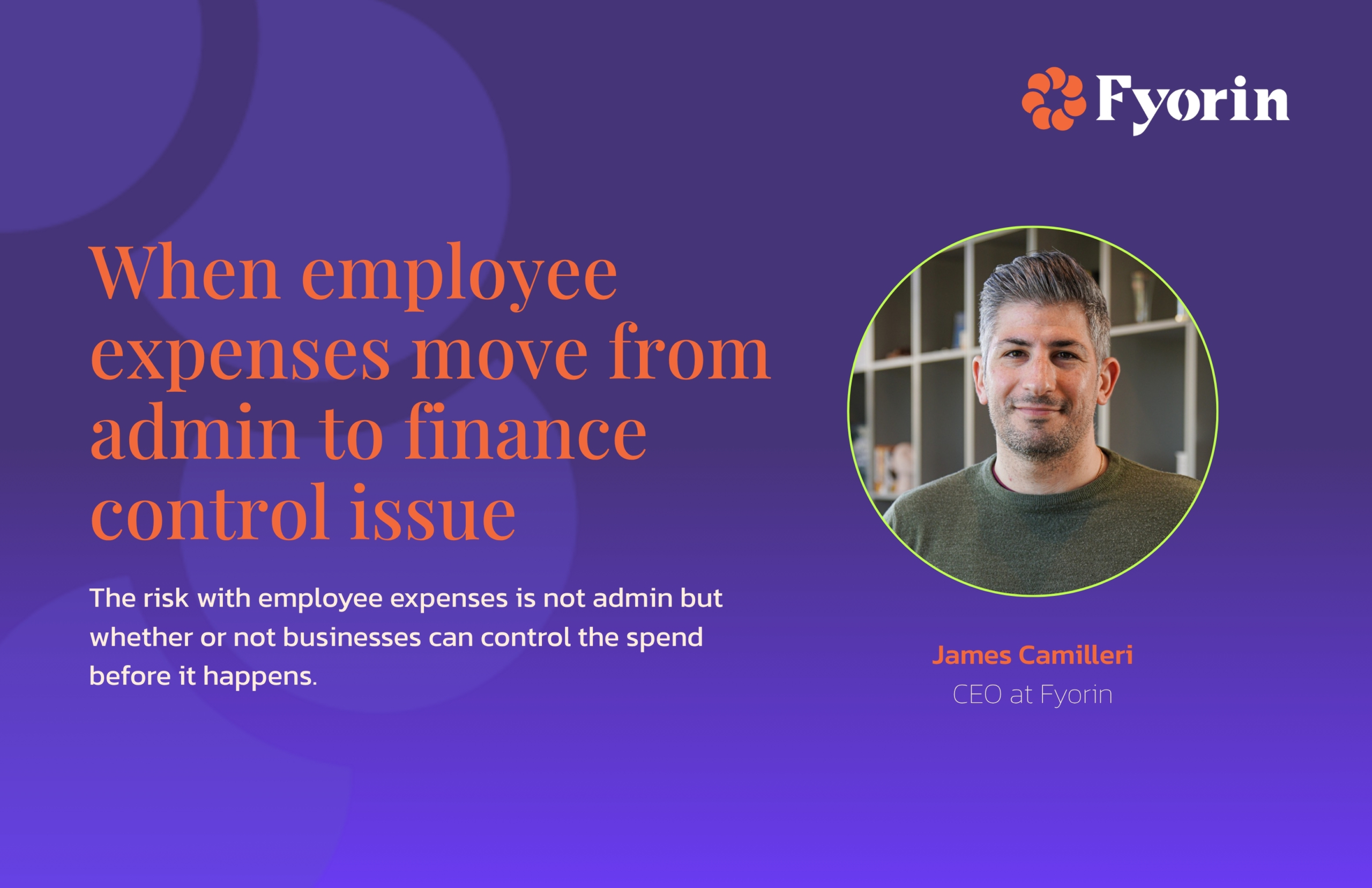
When employee expenses move from admin to a finance control issue
Employee spending gets treated as one of the smaller problems in finance – and looked at
individually, most of it is. A lunch, a subscription, a courier charge. The risk was never in any
single transaction but in what happens once this type of spending starts moving through a
business without anyone clearly owning and monitoring it.
The Risky Sequence
In conversations with businesses across industries and sizes, the same issues show up
because the sequence of events rarely changes.
- Cards linked to individual staff, not the business, so ownership isn’t clear once
someone changes role or leaves the business. - Employees pay out of pocket and receipts arrive later, if they arrive at all without
chasing. - Approval happens after the purchase, not before it, so policy violations are found too
late. - Categorisation is done at month-end instead of captured at the time of spend.
Add to that also subscriptions that often sit on personal or individual cards – invisible until a
renewal fails or a person leaves.
None of these create a crisis on its own, perhaps why CFOs usually leave expense
management as the last thing to deal with, an inconvenience rather than a core process.
When ignored for too long, finance ends up closing each small gap after the fact, without
ever having control at the moment it actually matters – before the money is spent.
Taking a closer look at “Small Spend”
Finance teams often talk about the ambiguous “small spend”. But what does it mean really?
Does it mean that the amounts spent are so small, that the business does not require much
process around it or that the process to handle the ‘small spend’ does not exist?
Consider this scenario: if an employee left your business tomorrow, could anyone say with
confidence which subscriptions, supplier payments or recurring charges were still sitting on
their card? Could they say who approved the last five purchases that person made, and was
it in line with the policy?
Another example. Picture a business where company cards are still linked to individual
employees. Someone resigns, changes role, or goes on extended leave. Their card doesn’t
stop being active just because they are not around. Subscriptions renew, supplier payments
continue, and finance only finds out when a payment fails or a manager asks an awkward
question.
Someone then has to reconstruct what that card was actually being used for, migrate
anything still needed, and cancel the rest, all without interrupting a supplier relationship or a
tool the business still depends on.
Tidying the mess of receipts and ‘small spend’ is one thing, another thing is the lack of
oversight before things become a problem, usually at month end.
Why Reimbursements Don’t Fix It
The usual response to the above is to tighten the process around reimbursement: more
forms, clearer policies, more frequent reminders to submit receipts. This treats the symptom.
Reimbursement, by definition, means the business finds out about a purchase after it’s
already happened.
The same is true of petty cash and personal-card spend more broadly. Each is a variation on
the same structure: money leaves first, and finance finds out, categorises and reconciles
second. Tightening the paperwork around that sequence doesn’t change the sequence.
Control That Starts Before the Spend
The alternative is deciding the rules before the money moves, not after. Business-owned
cards – not linked to a single employee, but owned by the company, let finance set who can
spend, how much, and on what, in advance. Receipts and categorisation become part of the
transaction, not a task someone remembers three weeks later.
This is what Fyorin offers – business-owned cards with approvals, limits and receipt capture
built into the spend itself, connected directly to the accounting system. Nobody has to
migrate a card when someone changes role, and nobody has to reconstruct what happened
after the fact, because the record was built at the time of spend.
Employee expenses were never really an admin problem. They’re a test of whether finance
controls spend before it happens, or is cleaning up after it – and that test gets harder, not
easier, as the business grows.
Article written and sponsored by James Camilleri, CEO, Fyorin